


Thank you!
© André Jacoby 2024


Task shedule with a timeline personalized für the nurse.


Exact room and bed number for orientation.
Basic overview of the patient, possibly information about abnormal findings.


Specific task overview for each patient.
Recording of any abnormal findings in the patient by voice input.


Automatic transcription of the words.

BRIEFING

TESTING FONT SIZES

USER TESTING
We then subjected the prototype to user testing. Our users were trained professionals from the nursing field. Their feedback helped us further expand our prototype with useful features and correct certain errors.

Delegate Tasks
Nurses need to be able to delegate tasks if there is no other option due to lack of time.

Wording
"Abnormal findings" and "Noted" had similar terms in the interface but represented different functions, so we needed clearer wording.

Clear Check-in
It must be clearly visible when you are checked in. And it is crucial where you place the check-in.

Reactive
Our solution must be as flexible and reactive as possible to make nurses’ everyday work easier and not hinder them even more.
The core element of our design is our task cards. They visually represent different task statuses, giving nurses a quick and clear overview. At a glance, they can see which patient a task is assigned to, whether it can be rescheduled, if there were any irregularities, or if a colleague is taking over the task during a shift change. These cards appear throughout our various use cases at different stages and times. We've distilled the most essential parameters for nurses into a simple, streamlined format, enabling them to quickly and efficiently scan key information – helping to ease their workload in high-pressure situations.


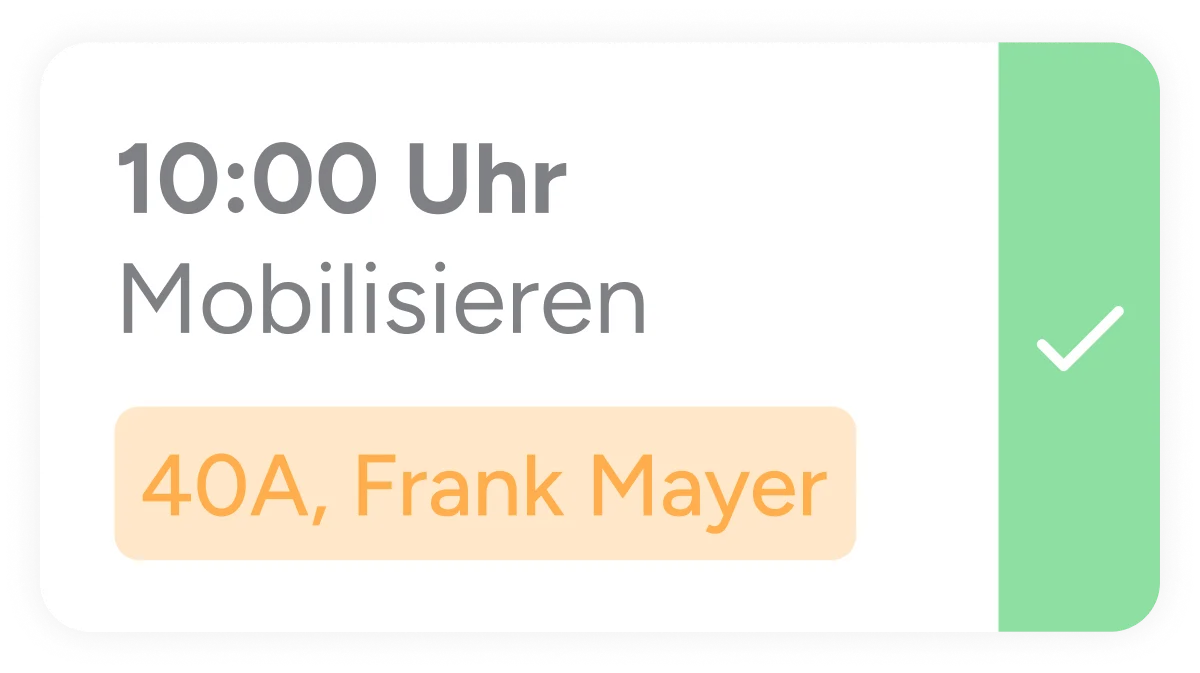

room, bed and patient
task done, anomaly “marked“
task done, anomaly recorded


Room and bed (several patients)
task not flexible
takeover by another caregiver
